


May 21 State Support for Out-of-School-Time Opportunities Continue to Increase; Local Partners Should Pair Investments with Strategy
(May 21, 2026)
Investing in Out-of-School Time (or OST) opportunities is a rare find that both sides of the aisle can agree on, and there are many reasons for it. Over and over again, OST engagement has shown to increase positive outcomes for students- including improved grades, social connection, attendance, and mental health, and reduce negative outcomes like violence, delinquency, and drop out rates.
Knowing this, it’s encouraging to see the various types of support given by our state and county to strengthen OST opportunities. In April, Lt. Governor Austin Davis announced roughly $2 million of grant funding to Allegheny County specific to OST programs via BOOST funding. The dollars from BOOST give many OST locations greater capacity to serve Pennsylvania students. Locally, RAND and a committee of non-profit partners released a new report and an incredible mapping tool to better understand the funding and OST landscape, offering insights into what gaps exist.
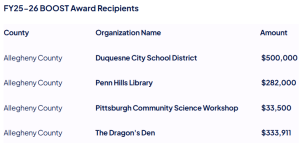
Click Here to see the full list of FY25-26 BOOST recipients across the state.
Despite the positives that the BOOST funding provides, the need for more OST programs, and other funding streams, remains. Federally, it has been estimated that for every one child in an OST program, three more are waiting to get in. In Allegheny County, the RAND report points out that, “if we simply divide the number of programs that we found by the number of youths in the county, there are 387 youths for each OST program…most providers in the county could not serve even half of this number.” It also highlights that despite the newer funding offered through BOOST (it was created in the 2024-2025 fiscal year), the biggest federal OST funding stream, 21st CCLC, is declining, stifling gains that the state funding could enhance. This period of change, from major investments once coming from federal dollars to now more locally offered funds, gives an opportunity for these local funders to thoughtfully consider where investments will make the greatest impact.
The incredible interactive map developed by RAND and the Allegheny County Department of Children Initiatives, allows the community to do just that. The map shows where OST offerings are abundant alongside areas with considerable gaps in programming, most notably in areas with high counts of vulnerable populations. As Pennsylvania continues to increase funding for OST programs, community partners and funders alike should be strategic about where these dollars are invested, using tools such as this map to make informed decisions. For example, focusing on “OST Deserts,” places with a high population of children and low offerings of OST programs, will make the greatest difference in the outcomes we all want to see for our youth until greater funding for more sites is available.
Even as the state budget allocates additional BOOST funding for the next fiscal year, there will always be more need than current funding can alleviate. Because of this, funders and community members alike should be strategic about how investments are made. With this in mind, Allies for Children is glad to see continued statewide investment in OST funding, and the incredibly thoughtful work of partners in Allegheny County to understand, advocate for, and expand the OST opportunities our children have available to them.
Keep an eye out in early June for a new blog from our partners at Allegheny Partners for Out-of-School Time on upcoming data from the Afterschool Alliance.
To read more about this topic, see our previous blogs:
Final PA Budget 2025-2026
Celebrating Out-of-School Time Investment in Harrisburg
Allegheny County Programs Receive Significant Funding for Out-of-School Time
Shauna McMillan, Consultant